How Electromagnetic Induction Steam Generators Are Transforming Manufacturing
Industrial steam plays an essential role in manufacturing. It is used for cleaning, sterilization, drying, humidification, curing, washing, food processing, textile finishing and many other production processes.
Traditionally, factories have generated steam by burning coal, diesel, natural gas or other fuels. Electric resistance boilers are also widely used where combustion is unsuitable. However, manufacturers are increasingly looking for steam-generation systems that offer faster startup, easier control, cleaner working environments and better compatibility with automated production.
An electromagnetic induction steam generator provides an alternative approach. Instead of using a flame or a resistance wire immersed in or attached directly to the heating chamber, the system uses electromagnetic induction to heat a specially designed conductive component. Heat is then transferred from that component to the water, producing steam.
This technology can help manufacturers improve process control while reducing some of the operational problems associated with conventional steam equipment.
What Is an Electromagnetic Induction Steam Generator?
An electromagnetic induction steam generator is an electrically powered system that converts water into steam through induction heating.
The system typically contains:
◆ An induction power supply
◆ An inverter and control system
◆ An induction coil
◆ A conductive heating chamber or heat exchanger
◆ A water supply system
◆ A steam outlet
◆ Temperature and pressure sensors
◆ Pressure-relief and electrical protection devices
Alternating current passes through the induction coil and creates a rapidly changing magnetic field. When a compatible metal heating body is placed within that magnetic field, electrical currents are induced inside the metal.
The resistance of the metal converts those currents into heat. The heated metal then transfers thermal energy to the water until steam is produced.
Therefore, induction does not usually heat the water itself directly. It heats a conductive metal component surrounding or contacting the water. This distinction is important when evaluating the design, efficiency and safety of an industrial induction steam system.
How Does an Electromagnetic Induction Steam Generator Work?
The steam-generation process can be divided into several stages.
1. Electrical Power Conversion
The machine receives electricity from a single-phase or three-phase power supply, depending on its rated capacity.
Power electronics convert the incoming electricity into controlled high-frequency alternating current. The operating frequency and output power are adjusted according to the generator design and required steam output.
2. Magnetic Field Generation
The high-frequency current flows through an induction coil.
This coil produces an alternating electromagnetic field around the conductive heating chamber. The induction coil itself is not intended to serve as the primary heating element.
3. Heat Generation Inside the Metal
When the conductive heating chamber is exposed to the alternating magnetic field, eddy currents are generated inside the metal.
The metal’s electrical resistance converts these currents into thermal energy. Depending on the material and frequency, magnetic hysteresis may also contribute to heating in ferromagnetic materials.
Because heat is generated in the metal body rather than transferred from an external flame, the system can respond quickly to changes in power settings.
4. Water Heating and Steam Production
Water enters the heating chamber or heat-exchange section and absorbs heat from the induction-heated metal.
As the water temperature rises to its boiling point under the operating pressure, it changes into steam. The steam then exits through the outlet and is delivered to the production equipment.
5. Automatic Process Control
Sensors continuously monitor operating conditions such as:
◆ Water level
◆ Steam temperature
◆ Steam pressure
◆ Input current
◆ Heating power
◆ Cooling-water flow
◆ Equipment temperature
The controller adjusts power output or stops heating when abnormal conditions are detected.
The exact configuration varies by model, so the complete installation should always be selected according to the required steam pressure, steam volume, water conditions and applicable pressure-equipment regulations.
Why Manufacturers Are Moving Toward Induction Steam Generation
Rapid Startup
Traditional industrial boilers may require a long preheating period before usable steam becomes available.
An induction steam generator can begin heating as soon as the system is activated. In appropriately sized systems, this can significantly shorten startup time and make steam available closer to the point of demand.
Fast startup is especially valuable for:
Factories can avoid keeping a large boiler running during long idle periods when steam is only needed occasionally.
Accurate Power Adjustment
Induction power supplies can regulate heating output electronically.
This allows manufacturers to match energy input more closely to actual production demand. Instead of operating continuously at full capacity, the system can reduce power when steam consumption falls and increase output when demand rises.
More precise control can help stabilize:
◆ Steam temperature
◆ Steam pressure
◆ Heating cycles
◆ Cleaning results
◆ Drying conditions
◆ Batch consistency
Cleaner Point-of-Use Operation
Electromagnetic induction steam generators do not require on-site combustion.
As a result, they do not produce combustion exhaust at the machine itself. This can simplify installation in facilities where fuel storage, burner ventilation, flue-gas treatment or chimney construction would be difficult.
The total environmental impact still depends on how the electricity is generated, but electrification can support manufacturers that are transitioning toward renewable electricity or lower-carbon production systems.
Reduced Dependence on Combustion Equipment
Fuel-fired boilers require burners, fuel-supply components, combustion-air systems and exhaust systems.
Electric induction systems eliminate many of these components. This may reduce maintenance associated with:
◆ Burner adjustment
◆ Fuel nozzles
◆ Soot accumulation
◆ Combustion chambers
◆ Fuel-storage systems
◆ Exhaust ducts
◆ Chimneys
However, induction steam generators still require routine inspection of electrical components, sensors, water circuits, pressure components and safety devices.
Compact Installation
Many induction steam generators are designed as compact, integrated units.
A smaller footprint can be useful for factories with limited equipment space or manufacturers that want to install steam generation near individual production lines.
Distributed steam generation may also reduce the need for long steam pipelines, although the most economical arrangement depends on the number of steam-using processes and total plant demand.
Compatibility With Automation
Electronic induction heating systems can be connected to PLCs, sensors and production-line controls.
They may be configured for:
◆ Automatic startup and shutdown
◆ Temperature-controlled operation
◆ Pressure-controlled operation
◆ Timed heating cycles
◆ Alarm monitoring
◆ Remote control
◆ Production-line interlocking
This makes induction steam generation suitable for factories seeking more repeatable and digitally controlled thermal processes.
Industrial Applications of Induction Steam Generators
Industrial Steam Cleaning
Steam is used to remove oil, grease, residue and contaminants from machinery, metal components and production equipment.
Rapid-start electric steam generators are suitable for cleaning stations that operate periodically rather than continuously.
Textile Processing
Textile manufacturers use steam for washing, drying, ironing, setting, finishing and fabric-conditioning processes.
Consistent steam temperature and pressure can help maintain stable processing conditions while reducing delays between production batches.
Food Processing and Packaging
Steam may be used in:
The generator must be selected according to the hygiene, pressure and steam-quality requirements of the application. Direct food-contact applications may require additional water-treatment and sanitary-design measures.
Laundry and Garment Care
Commercial laundries, garment factories and dry-cleaning facilities use steam for ironing, pressing, drying and fabric treatment.
Compact induction steam generators can provide a localized steam source for individual workstations or production sections.
Concrete Curing
Controlled steam can accelerate concrete curing under suitable conditions.
This may be used in precast concrete factories and selected bridge, railway and construction-component production processes. Steam temperature, humidity and curing time must be controlled to avoid damaging the concrete.
Chemical and Biochemical Processing
Steam can provide indirect heat for:
◆ Fermentation tanks
◆ Mixing vessels
◆ Emulsifiers
◆ Reactors
◆ Cleaning systems
◆ Process pipelines
System materials, steam purity and operating pressure must be compatible with the chemical process.
Hotels, Schools and Commercial Facilities
Electric steam and hot-water systems may also be used for cleaning, laundry, sanitation and selected hot-water applications in commercial facilities.
Induction Steam Generator vs. Traditional Steam Boiler
| Comparison Factor | Induction Steam Generator | Traditional Fuel-Fired Boiler |
|---|
| Energy source | Electricity | Gas, diesel, coal or other fuel |
| On-site combustion | No | Yes |
| Startup | Generally fast | Often requires preheating |
| Power adjustment | Electronic and responsive | Depends on burner control |
| Local exhaust | No combustion exhaust | Flue-gas system required |
| Installation footprint | Often compact | Frequently larger |
| Fuel storage | Not required | May be required |
| Best suited for | Localized, intermittent or controlled steam demand | Large centralized or continuous steam demand |
Neither technology is automatically the best choice for every factory.
A large plant with continuous high-volume steam consumption may still benefit from a centralized boiler system. A smaller production line with intermittent steam demand may gain more value from a compact induction steam generator.
The decision should be based on actual operating cost, electricity price, fuel price, steam consumption, operating hours, pressure requirements and installation conditions.
The Role of Water-Cooled Induction Heating Machines
An electromagnetic induction steam generator and a water-cooled induction heating machine use related electromagnetic principles, but they are not the same type of equipment.
An induction steam generator is specifically engineered to heat water and deliver steam through a pressure-controlled system.
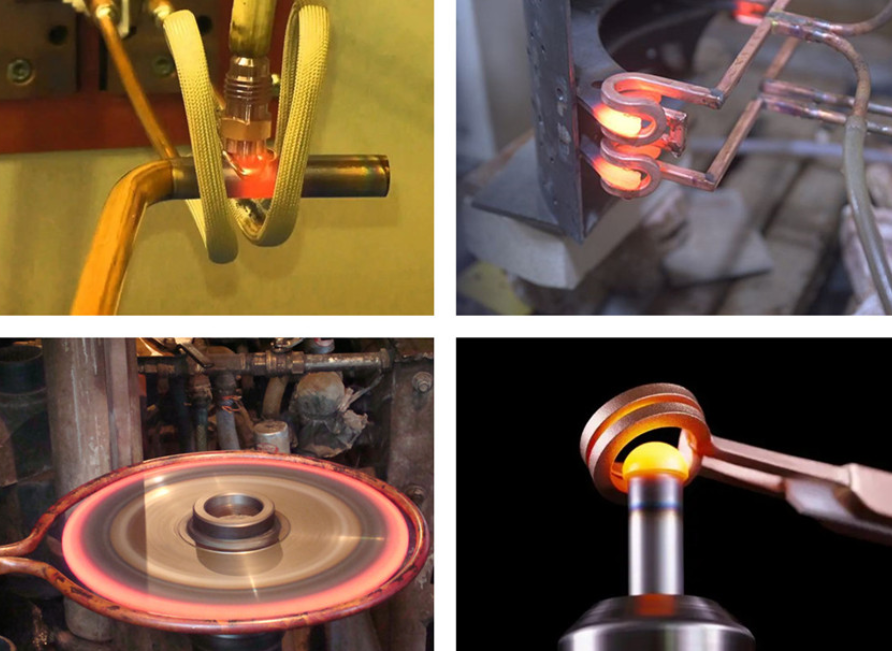
A water-cooled induction heating machine is primarily designed to heat conductive metal workpieces for processes such as:
◆ Brazing
◆ Soldering
◆ Welding
◆ Surface hardening
◆ Quenching
◆ Annealing
◆ Tempering
◆ Forging preheating
◆ Shrink fitting
◆ Thermal assembly
The water circuit in this type of machine cools the induction coil, transformer, power electronics or other core components. Cooling prevents excessive temperature buildup and supports stable operation during repeated or continuous heating cycles.
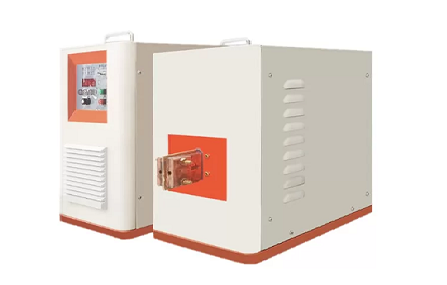
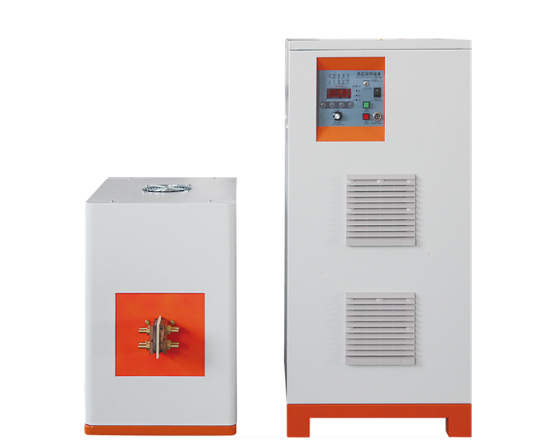
Hitfar’s water-cooled induction heating range includes high-frequency, ultra-high-frequency, medium-frequency and super-audio-frequency equipment. Available products cover different power and frequency ranges for small precision parts, tools, pipes, gears, shafts and heavier industrial components.
For example, the ZG-HF15 water-cooled high-frequency machine provides adjustable output from 5 to 15 kW at 30–100 kHz. It is designed for applications such as heating, brazing, soldering and welding, and includes cooling-water and electrical protection functions.
At the higher end of the range, the ZG-UHF160 provides adjustable output up to 160 kW at 80–200 kHz. It is intended for industrial heat-treatment processes such as surface hardening, quenching, annealing and tempering.
This means a manufacturer may use two different induction solutions within the same facility:
◆ An induction steam generator for cleaning, processing, drying or curing
◆ A water-cooled induction heating machine for direct metal heating and heat treatment
Together, these technologies can replace several less controllable flame-based heating processes.
Why Water Cooling Matters in Industrial Induction Heating
Induction coils carry high-frequency electrical current and operate close to heated workpieces. Without sufficient cooling, coil temperature can increase rapidly.
A properly designed water-cooling system helps:
◆ Maintain a stable coil temperature
◆ Protect power electronics and transformers
◆ Support longer operating cycles
◆ Reduce unplanned shutdowns
◆ Improve process repeatability
◆ Extend the service life of critical components
Cooling requirements must be matched to the machine. Important factors include cooling-water flow, pressure, inlet temperature, water quality and chiller capacity.
Insufficient flow, blocked pipes or excessive water temperature can activate machine protection or damage components. Manufacturers should therefore include cooling-system inspection in their preventive-maintenance schedule.
How to Select the Right Induction Heating Solution
Before selecting an induction steam generator, provide the supplier with the following information:
Required Steam Output
Steam demand is normally expressed in kilograms per hour. The selected generator must supply enough steam during peak operation, not only under average conditions.
Operating Pressure and Temperature
Different cleaning, curing and processing applications require different steam conditions. Pressure-related components must be designed and certified for the intended working range.
Production Schedule
Consider whether steam is required continuously, in batches or only for short periods. Intermittent demand may favor a rapid-start point-of-use system.
Available Electrical Supply
Confirm:
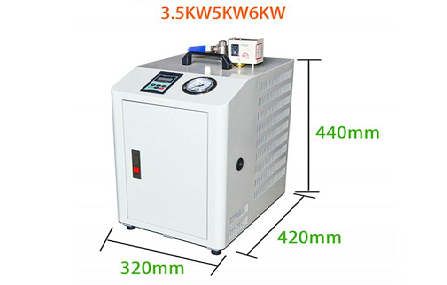
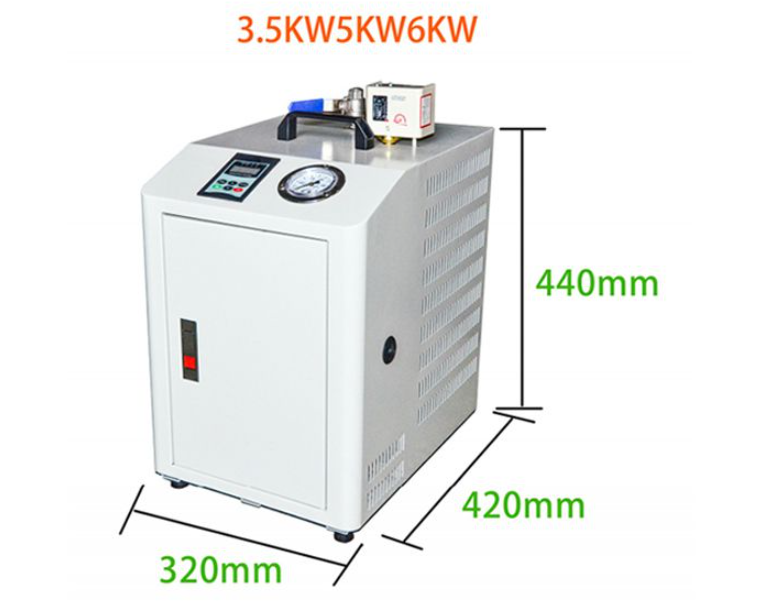
Hitfar lists induction steam generator models from 3.5 to 60 kW in its ZG-EH-SG range, with both single-phase and three-phase configurations depending on capacity. The listed steam-output range extends from approximately 5 to 85 kg/h across these models.
Water Conditions
Water hardness and dissolved minerals can affect scale formation and heat-transfer performance.
Although some systems can operate with normal tap water, water quality should still be evaluated. Filtration, softening or scheduled descaling may be necessary in hard-water regions.
Installation Environment
Evaluate available space, ambient temperature, drainage, ventilation, electrical protection and access for maintenance.
Control Requirements
Factories may require manual operation, automatic timing, pressure control, temperature control or integration with an existing PLC system.
Safety Considerations
Induction heating eliminates an open flame, but an industrial steam system still involves electricity, hot surfaces and pressurized steam.
A complete installation should include appropriate:
◆ Overcurrent protection
◆ Overvoltage protection
◆ Overtemperature protection
◆ Water-level monitoring
◆ Pressure monitoring
◆ Pressure-relief devices
◆ Emergency shutdown controls
◆ Grounding
◆ Pipe insulation
◆ Drainage and blowdown arrangements
Installation and operation should comply with the pressure-equipment, boiler, electrical and workplace-safety requirements applicable in the destination country.
Operators should never bypass alarms or safety devices, and inspection intervals should follow the manufacturer’s instructions and local regulations.
The Future of Electromagnetic Induction in Manufacturing
Industrial heating is becoming more electrified, automated and data-driven.
As factories adopt renewable electricity, energy-management systems and intelligent production lines, electromagnetic induction technology is likely to play a larger role in both fluid heating and metal processing.
Future systems may offer:
◆ More precise digital control
◆ Real-time energy monitoring
◆ Predictive maintenance
◆ Remote fault diagnosis
◆ Modular steam capacity
◆ Better heat recovery
◆ Closer integration with robotic production
◆ Automatic adjustment according to process demand
However, successful implementation depends on proper system sizing. Induction technology should not be selected solely because of its heating speed. Manufacturers should evaluate the complete production process, including energy cost, required output, cooling conditions, steam distribution and maintenance capability.
Conclusion
Electromagnetic induction steam generators provide manufacturers with a fast, controllable and combustion-free method of producing industrial steam at the point of use.
Their compact structure and electronic power control make them especially valuable for cleaning, textiles, food machinery, laundry, curing and other applications with localized or intermittent steam demand.
For factories that also require rapid and precise metal heating, Hitfar’s water-cooled induction heating machines provide a complementary solution. With high-frequency, ultra-high-frequency and medium-frequency options, these machines can support brazing, welding, hardening, quenching, annealing and other industrial heat-treatment processes.
Selecting the correct equipment begins with understanding the workpiece or steam requirement, required output, operating frequency, production cycle, power supply, cooling conditions and automation needs.
Contact Hitfar with your process details to receive a recommended induction heating configuration for your production line.