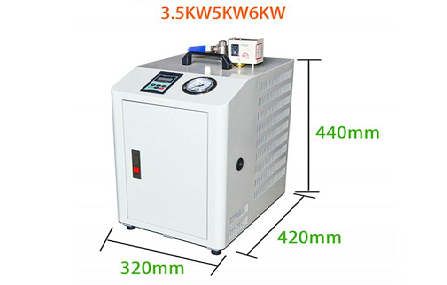
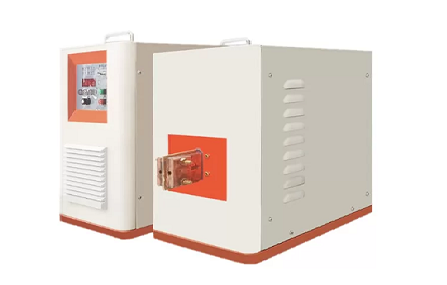
Induction heating is used in everything from brazing small electrical contacts to hardening large shafts and heating billets before forging. Unlike a gas torch or industrial furnace, it does not depend on an open flame or a hot surface to transfer heat into a metal component.
Instead, an induction heating system generates heat directly inside an electrically conductive workpiece. This allows a manufacturer to heat a selected area quickly while limiting unnecessary heating of the surrounding material.
The induction coil is the component that makes this possible. It creates the alternating magnetic field, directs energy toward the workpiece, and strongly influences the shape and depth of the heated area.
To understand how an induction heater works, it is therefore necessary to look at both the electromagnetic heating principle and the design of the induction coil.
What Is Induction Heating?
Induction heating is a non-contact process used to heat electrically conductive materials through electromagnetic induction.
A power supply converts ordinary electrical power into alternating current at a suitable frequency. This current passes through a copper induction coil and produces a rapidly changing magnetic field around it.
When a conductive workpiece is placed inside or close to the coil, the changing magnetic field induces circulating electrical currents within the material. These are known as eddy currents.
The workpiece has natural electrical resistance. As the eddy currents flow through that resistance, electrical energy is converted into heat. The component therefore becomes its own heat source instead of receiving heat from a flame, furnace atmosphere, or external heating element.
This is why induction heating can respond so quickly. Energy is delivered directly to the metal and can be concentrated in the area where heating is required.
How Does Induction Heating Work?
Although an industrial induction system contains sophisticated power electronics, the basic heating process can be explained in four stages.
1. Alternating Current Flows Through the Coil
The induction power supply sends alternating current through the work coil. Because the direction of the current changes continuously, the magnetic field around the coil also changes continuously.
2. The Coil Creates an Alternating Magnetic Field
The magnetic field is strongest close to the coil conductors. Its distribution is influenced by the coil geometry, the number and spacing of its turns, and the position of the workpiece.
3. Eddy Currents Are Induced in the Workpiece
When a metal part enters the magnetic field, electrical currents begin circulating inside it. In this sense, the coil and workpiece operate somewhat like the primary and short-circuited secondary sides of a transformer.
No physical electrical connection is required between them. Energy is transferred across the space between the coil and workpiece through the electromagnetic field.
4. Electrical Resistance Generates Heat
As the eddy currents flow through the metal, resistance converts their electrical energy into heat. The strongest heating usually begins near the surface and then moves farther into the component through thermal conduction.
In magnetic materials such as carbon steel, hysteresis losses can also contribute to heating below the material’s Curie temperature. However, eddy-current losses remain the main heating mechanism in many industrial induction processes.
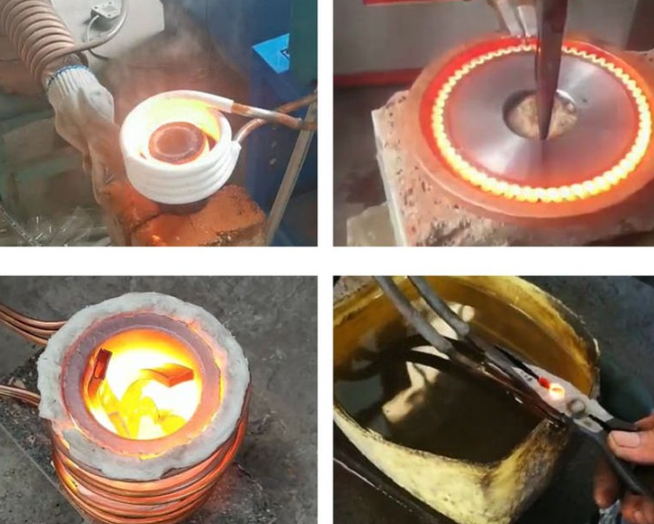
What Is an Induction Heating Coil?
An induction heating coil, also called a work coil or inductor, is the conductor that creates the electromagnetic field used to heat the workpiece.
Industrial coils are usually made from highly conductive copper tubing. Copper carries large electrical currents efficiently and can be bent, machined, or brazed into shapes that match different components.
Most industrial induction coils are hollow because cooling water must circulate through them. The water removes heat created by electrical losses and heat radiated from the nearby workpiece.
The coil itself is not intended to function like a resistance heating element. Its main job is to transfer energy from the induction power supply to the workpiece. When the process is operating correctly, most of the useful heat is generated in the part rather than in the coil.
How Does the Induction Coil Control the Heating Pattern?
The shape of an induction coil influences where the electromagnetic field is concentrated. For this reason, coil design has a direct effect on heating speed, temperature uniformity, process efficiency, and finished-part quality.
Consider a round steel bar. If the bar is placed inside a helical coil, the magnetic field surrounds its outside surface and can heat a defined length of the bar. A flat plate, by comparison, may be heated with a pancake coil positioned above its surface. A pipe bore may require a smaller internal coil that directs energy toward the inside wall.
The coil must therefore be designed around both the workpiece and the intended heating result.
A longer multi-turn coil may distribute heat across a larger section, while a narrow single-turn coil can concentrate energy in a smaller area. Coil spacing may be adjusted to correct uneven temperature patterns, and magnetic flux concentrators may be added when energy needs to be directed more precisely.
Coil design must also account for how the part enters the heating position. A coil used in an automated production line may need to accommodate conveyors, robots, rotation systems, or scanning movement without sacrificing heating consistency.
Why Is the Coil-to-Workpiece Distance Important?
The distance between the coil and the metal component is known as the coupling gap.
A smaller gap generally produces stronger electromagnetic coupling. More energy is transferred into the nearby area of the workpiece, increasing local current density and heating intensity.
However, the coil should not simply be positioned as close as physically possible. Space may be needed for part loading, dimensional tolerances, thermal expansion, vibration, and automated movement. If the workpiece touches the coil, it can damage the copper tubing or electrical insulation.
A larger gap offers more mechanical clearance but weakens energy transfer. It may result in a slower heating cycle or require more power to achieve the same temperature.
The correct coupling gap is therefore a balance between:
In some heat-treatment processes, engineers intentionally vary the gap along the coil to increase or reduce heating in selected areas.
How Does Frequency Affect Induction Heating?
Frequency determines how rapidly the current and magnetic field alternate. It also has a major influence on how deeply the induced current penetrates into the material.
Because of the skin effect, eddy-current density is greatest close to the surface of the workpiece and decreases toward the center. As frequency increases, the current becomes more concentrated near the surface. Lower frequencies allow deeper penetration.
| Frequency Selection | General Heating Result | Typical Applications |
|---|
| Lower frequency | Deeper penetration and better through-heating of larger sections | Billet heating, forging, large components and melting |
| Medium frequency | Balance between surface concentration and penetration | General heat treatment, preheating and medium-sized parts |
| High frequency | Faster, shallower and more localized heating | Brazing, soldering, small-part hardening and tube heating |
| Ultra-high frequency | Very shallow heating in small or precise areas | Fine brazing, miniature components and localized surface treatment |
These categories are general rather than absolute. The actual heating depth also depends on the material’s electrical resistivity and magnetic permeability, as well as its temperature, dimensions, power density, and heating time.
For example, a high-frequency system may generate heat mainly near the surface, but holding the part in the coil for longer allows thermal conduction to carry that heat deeper into the material.
Common Types of Induction Coils
Induction coils can be customized for highly specific parts, but most designs are based on several common configurations.
| Coil Type | Basic Design | Common Uses |
|---|
| Helical or solenoid coil | Multiple turns surrounding a cylindrical part | Heating rods, bars, tubes, shafts and billets |
| Single-turn coil | One copper turn concentrated around a narrow area | Localized brazing, soldering and hardening |
| Pancake coil | Flat spiral positioned beside a surface | Heating plates, flat components and container bottoms |
| Hairpin coil | Two parallel conductors joined at one end | Linear heating, seams and scanning processes |
| Channel coil | Coil arranged along a production path | Continuous heating of strip, wire or tubing |
| Internal coil | Small coil inserted inside a hollow component | Heating pipe interiors, sleeves and bores |
| Contoured coil | Custom shape following the workpiece geometry | Gears, tools, joints and irregular components |
There is no universally best coil design. A simple helical coil may be ideal for a round bar, while a more complex machined coil may be required to heat only the teeth of a gear or a narrow section of an assembly.
The correct design is the one that produces the required heating pattern while maintaining adequate water flow, electrical efficiency, mechanical strength, and access for loading the workpiece.
Does Induction Heating Work on All Metals?
Induction heating is not limited to magnetic metals. It can be used with many electrically conductive materials, including:
Magnetic materials often heat readily because both eddy-current and hysteresis effects may contribute during part of the heating cycle.
Non-magnetic materials such as aluminum and copper can also be heated, although their high electrical conductivity may require a different combination of power, frequency, coil design, and coupling distance.
Glass, plastics, and most conventional ceramics cannot normally be heated directly because they do not conduct enough electrical current. They can sometimes be heated indirectly by using a conductive susceptor, such as graphite, that absorbs induction energy and transfers heat to the non-conductive material.
Why Are Induction Heating Coils Water-Cooled?
Large alternating currents pass through an industrial induction coil during operation. Even though copper has low electrical resistance, some energy is still converted into heat inside the tubing.
The coil is also positioned close to a workpiece that may reach brazing, hardening, forging, or melting temperatures. Radiant heat from the component adds to the thermal load.
Without sufficient cooling, an induction coil may overheat, soften, oxidize, deform, or suffer premature joint and insulation failure.
A water-cooling circuit circulates coolant through the hollow copper tube and may also cool the power supply, capacitors, cables, and workhead. Stable cooling supports longer production cycles and helps keep the electrical characteristics of the system consistent.
For reliable operation, users should pay attention to:
◆ Cooling-water flow and pressure
◆ Inlet water temperature
◆ Water quality and conductivity
◆ Scale or blockage inside the coil
◆ Leaks at hoses and brazed connections
Water cooling is especially important in high-power systems and equipment used repeatedly or continuously.
Induction Heating vs. Conventional Heating
Induction heating is often compared with flame, furnace, and resistance heating. Each method has suitable applications, but they deliver energy in different ways.
| Comparison | Induction Heating | Conventional External Heating |
|---|
| Heat source | Heat is generated in the conductive workpiece | Heat is transferred from a flame, element or hot atmosphere |
| Heating area | Can be concentrated in a selected zone | Often heats a larger surrounding area |
| Response time | Power can be applied and stopped rapidly | Furnace or burner conditions may change more slowly |
| Physical contact | Usually not required | Depends on the heating method |
| Process repeatability | Power and cycle time can be programmed | May be more affected by operator or furnace conditions |
| Open flame | Not required | Used in torch and gas-fired processes |
| Tooling requirement | Requires a suitable induction coil | Requires a burner, furnace, element or heating fixture |
One of induction heating’s main advantages is not simply that it can heat quickly, but that it can deliver heat to a controlled location for a controlled period.
This selective heating can reduce unnecessary thermal exposure, shorten cycle time, and make the process easier to integrate into automated production.
Where Is Induction Heating Used?
Induction heating is used across automotive, aerospace, electrical, toolmaking, metalworking, appliance, energy, and general manufacturing industries.
Induction Brazing and Soldering
The coil heats a joint until the filler alloy melts and flows between the components. Because the heating area can be localized, induction is suitable for cutting tools, copper tubing, electrical contacts, refrigeration parts, and motor assemblies.
Induction Hardening
The surface of a steel component is heated rapidly and then quenched. The process creates a hard, wear-resistant outer layer while retaining a tougher core. Gears, shafts, pins, sprockets, and bearing components are frequently treated this way.
Annealing and Tempering
Controlled induction heating can soften metal, relieve residual stress, improve ductility, or modify the microstructure of a previously hardened component.
Forging and Hot Forming
Bars and billets can be heated before mechanical forming. Induction systems are often integrated with feeders and forging presses to support repeatable production.
Shrink Fitting
An outer component is heated so that it expands. Another part is inserted, and the assembly forms a tight interference fit as it cools.
Other applications include metal melting, welding, tube heating, coating removal, preheating, straightening, and heat treatment of welded seams.
What Are the Main Advantages of Induction Heating?
When properly matched to the application, induction heating can provide several practical benefits:
◆ Fast response: Energy begins heating the workpiece as soon as power is applied.
◆ Localized heating: Only the required section of the component needs to be heated.
◆ Repeatable cycles: Power, time, movement, and temperature can be controlled automatically.
◆ Cleaner operation: The process does not require combustion at the heating point.
◆ Production-line integration: Coils can work with conveyors, robots, scanners, and quenching systems.
◆ Reduced surrounding heat: Less energy is spent heating the atmosphere and nearby equipment.
These advantages depend on correct system design. An unsuitable frequency or poorly matched coil can still produce slow heating, temperature variation, or excessive energy use.
What Information Is Needed to Select an Induction Heating System?
Selecting an induction heater should begin with the workpiece and process rather than with the machine’s power rating alone.
An equipment supplier will normally need to know:
◆ Workpiece material, dimensions and weight
◆ Area or depth that must be heated
◆ Target temperature
◆ Required heating time
◆ Parts produced per hour
◆ Manual or automatic loading method
◆ Available electrical power and cooling conditions
A part drawing or physical sample can be especially useful when the heating area is complex. Application testing may then be used to confirm the required power, operating frequency, coil shape, coupling gap, cycle time, and temperature distribution.
A higher-power machine is not automatically the better choice. Too much surface power can overheat the outside of a component before sufficient heat reaches the required depth. The power supply, frequency, coil, cooling circuit, and workpiece must be evaluated as a complete system.
Frequently Asked Questions
Does the induction coil touch the workpiece?
No physical contact is normally required. A controlled gap is maintained between the coil and workpiece to support efficient coupling while preventing collision, arcing, or mechanical damage.
Does the coil itself become hot?
The coil can absorb heat through electrical losses and radiation from the workpiece, but it is not intended to be the main heating element. Cooling water is used to control its temperature.
Does higher frequency mean faster heating?
Not always. Higher frequency generally produces shallower heating, but heating speed also depends on power, material properties, coil design, coupling distance, and part size.
Can one coil be used for several products?
One coil may work with components that have similar dimensions and heating requirements. Significant changes in shape, size, or target heating area usually require another coil.
Why does a part heat unevenly inside a coil?
Uneven heating may result from inconsistent positioning, an unsuitable coupling gap, irregular coil spacing, edge effects, part geometry, or incorrect power and frequency selection.
Water-Cooled Induction Heating Solutions for Industrial Production
The induction coil determines where energy is delivered, but stable industrial production also depends on a power supply and cooling system suited to the application.
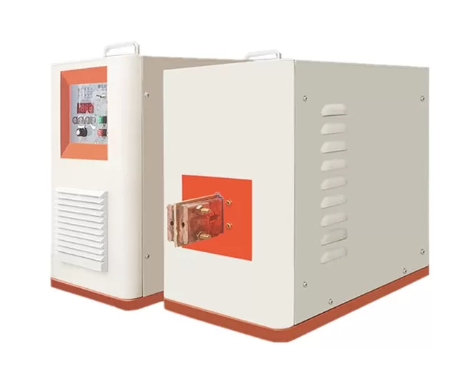
Hitfar provides water-cooled induction heating machines for metal brazing, soldering, welding, hardening, quenching, annealing, preheating, and other industrial heating processes. The available product range includes medium-, high-, and ultra-high-frequency configurations for applications ranging from localized precision heating to higher-power production requirements.
The integrated water-cooling arrangement helps control coil and system temperature during repeated operating cycles. Adjustable power output also allows the heating process to be matched more closely to the workpiece material, dimensions, target temperature, and required heating speed.
Explore our water-cooled induction heating machines to compare available frequency and power options. To receive an application-specific recommendation, provide your workpiece drawing, material, heating area, target temperature, cycle time, and expected production output. Hitfar can help evaluate the process and recommend a suitable induction heater and coil configuration.