Modern metal processing requires heating systems that can deliver consistent temperatures, shorter production cycles, efficient energy use, and reliable process control. Traditional gas, flame, and resistance heating methods can meet some industrial requirements, but they may also cause heat loss, uneven heating, oxidation, and longer processing times.
A medium frequency induction heating machine provides an alternative heating method based on electromagnetic induction. Instead of transferring heat primarily from an external flame or heating element, induction heating generates electrical currents directly inside the conductive workpiece.
This makes medium frequency induction heating suitable for a wide range of industrial applications, including forging, heat treatment, preheating, brazing, shrink fitting, and metal melting.
What Is a Medium Frequency Induction Heating Machine?
A medium frequency induction heating machine is an industrial heating system that uses electromagnetic induction to heat electrically conductive materials.
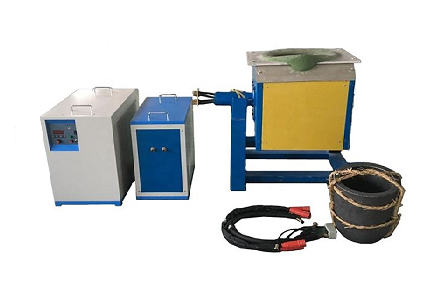
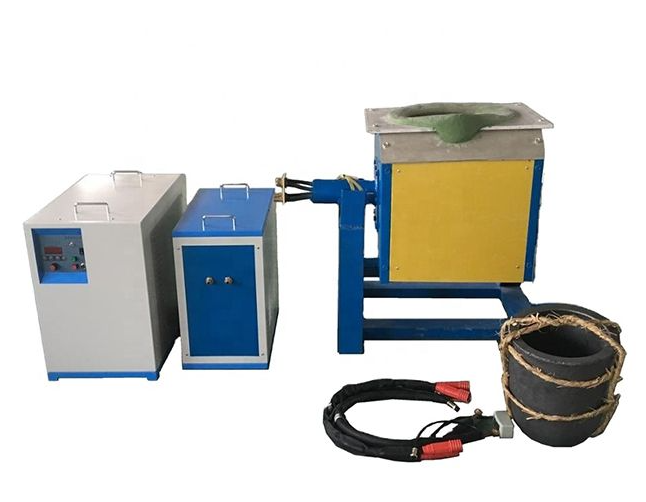
The system generally consists of an induction power supply, an induction coil, a cooling system, and corresponding control components.
The heating process works as follows:
1. Alternating current flows through the induction coil.
2. The coil generates an alternating electromagnetic field.
3. The electromagnetic field induces eddy currents inside the metal workpiece.
4. Electrical resistance within the workpiece converts the induced current into heat.
5. The metal reaches the required processing temperature without direct contact with the heating source.
Medium frequency induction heating commonly operates in a frequency range of approximately 1 kHz to 10 kHz, although the exact frequency range can vary depending on equipment design and application requirements.
The appropriate frequency, power output, coil configuration, and heating time depend on the material, workpiece dimensions, required heating depth, target temperature, and production process.
How Does Medium Frequency Induction Heating Improve Industrial Efficiency?
The efficiency advantages of induction heating come from more than simply heating metal quickly. The technology combines localized energy transfer, controllable heating parameters, repeatability, and compatibility with automated production systems.
1. Faster Heating and Shorter Production Cycles
Induction heating generates heat directly inside the conductive workpiece, allowing energy to be transferred without relying primarily on conduction from an external heating element.
This can significantly shorten heating cycles compared with some conventional heating methods.
In forging operations, for example, steel billets can be rapidly heated to the required forming temperature before entering a press or forging machine. Shorter heating cycles can increase production throughput and reduce waiting time between processing stages.
Actual heating speed depends on factors such as:
◆ Material type
◆ Workpiece size
◆ Initial temperature
◆ Target temperature
◆ Heating depth
◆ Power output
◆ Frequency
◆ Coil design
Therefore, the heating performance of a medium frequency induction heating machine should always be evaluated according to the complete production process.
2. More Precise Temperature Control
Consistent temperature is important for forging, heat treatment, brazing, and other metalworking processes.
Induction heating allows operators to control parameters such as power, frequency, heating time, and coil configuration. This makes it possible to establish repeatable heating cycles for specific workpieces.
Better process control can help reduce:
For automated production, repeatable heating parameters are especially valuable because the same heating cycle can be applied to successive workpieces.
3. Localized Energy Transfer
One of the major advantages of induction heating is that heat can be concentrated in a specific area of the workpiece.
Unlike furnace heating, which may heat the entire surrounding environment, induction heating can be designed around the required heating zone.
This is useful when only part of a component needs to reach a specific temperature.
Localized heating can help:
◆ Reduce unnecessary heating
◆ Protect surrounding areas
◆ Improve processing accuracy
◆ Shorten heating cycles
◆ Reduce thermal exposure
The heating pattern can be adjusted through the frequency, coil geometry, power level, and position of the workpiece.
4. Reduced Heat Loss
Conventional heating systems may lose energy through hot air, furnace walls, combustion gases, and other components surrounding the workpiece.
Induction heating generates heat within the conductive material itself. Because the heating process can be localized, less energy needs to be spent heating the surrounding environment.
This can improve energy utilization, particularly in applications involving repeated heating cycles and high production volumes.
Actual energy consumption varies according to equipment efficiency, material properties, production rate, target temperature, workpiece geometry, and the heating method used for comparison.
5. Cleaner Heating
Gas and flame-based heating can produce combustion gases and may expose metal surfaces to an oxidizing atmosphere.
Induction heating does not require an open flame. This allows manufacturers to create a cleaner heating process and can help reduce excessive oxidation and scale formation under appropriate operating conditions.
For applications such as forging and heat treatment, reduced surface oxidation may help decrease material loss and subsequent cleaning requirements.
The actual level of oxidation depends on the material, temperature, heating atmosphere, and process conditions.
6. Better Process Repeatability
Industrial production requires consistent results from one workpiece to the next.
A medium frequency induction heating machine can be programmed with defined heating parameters, allowing manufacturers to establish repeatable production cycles.
For example, a production process may specify:
◆ Heating power
◆ Frequency
◆ Heating time
◆ Target temperature
◆ Holding time
◆ Cooling conditions
Once these parameters have been validated, they can be applied consistently to subsequent production batches.
This repeatability is particularly useful for mass production and automated manufacturing.
Applications of Medium Frequency Induction Heating Machines
Medium frequency induction heating is suitable for many industrial metalworking applications.
Induction Heating for Forging
Forging requires metal billets or bars to reach an appropriate temperature before mechanical forming.
A medium frequency induction heating machine can rapidly heat steel bars, billets, and other conductive materials before forging.
Common benefits include:
◆ Rapid heating
◆ Consistent temperature
◆ Reduced surface oxidation
◆ Repeatable heating cycles
◆ Easy integration with forging lines
For high-volume production, continuous induction heating can help maintain a stable material supply for downstream forging equipment.
Induction Heating for Heat Treatment
Induction heating is widely used for metal heat treatment processes such as:
◆ Hardening
◆ Annealing
◆ Normalizing
◆ Tempering
◆ Stress relieving
For components such as shafts, gears, bearings, and other mechanical parts, induction heating can provide controlled heating before subsequent cooling or treatment stages.
Medium frequency systems can be particularly useful when greater heating penetration or bulk heating is required.
The final heating depth depends on frequency, material properties, workpiece geometry, coil design, and process parameters.
Induction Heating for Metal Melting
Medium frequency induction heating is also used in induction melting systems.
During induction melting, electromagnetic energy produces heat within the metal charge, allowing conductive metals to be heated until they reach their melting temperature.
Applications may include melting:
Induction melting can provide controlled heating and is suitable for both batch and continuous industrial processes, depending on furnace configuration.
Induction Preheating
Preheating is often required before welding, forging, forming, or other thermal processes.
A medium frequency induction heating machine can provide controlled preheating around a defined area of a component.
Compared with manual flame heating, an induction system can provide more repeatable temperature control and can be integrated with temperature monitoring equipment.
This makes induction preheating suitable for pipes, vessels, structural components, and other fabricated metal products.
Induction Post-Weld Heat Treatment
Post-weld heat treatment (PWHT) is used in various industrial applications to control residual stresses and achieve required material properties.
Induction heating can provide controlled heating around welded areas while maintaining a defined temperature profile.
The system can be configured with temperature sensors and automatic control to maintain the required heating cycle.
This approach can be useful for large pipes, pressure vessels, steel structures, and other fabricated components.
Induction Brazing
Induction brazing uses electromagnetic induction to heat the joint area and melt the brazing filler material.
Because heating can be concentrated around the joint, induction brazing can provide accurate and repeatable results while limiting unnecessary heating of surrounding components.
Typical applications include:
Induction Shrink Fitting
Induction heating can also be used for shrink fitting.
A metal component is heated to expand it temporarily before it is assembled with another component. After cooling, the resulting interference fit creates a secure connection.
Induction heating is useful for this process because the heating area and temperature can be controlled without directly contacting the workpiece.
Medium Frequency vs. High Frequency Induction Heating
Frequency is an important consideration when selecting an induction heating system.
In general, lower frequencies provide greater heating penetration, while higher frequencies tend to produce more localized heating near the surface.
However, heating depth is not determined by frequency alone. Material properties, workpiece geometry, coil design, power density, and heating time also affect the final heating result.
| Factor | Medium Frequency Induction | High Frequency Induction |
|---|
| Typical frequency | Approximately 1–10 kHz | Generally higher than medium frequency |
| Heating tendency | Greater penetration | More localized heating |
| Common applications | Forging, melting, bulk heating, heat treatment | Surface hardening, brazing, localized heating |
| Suitable workpieces | Medium and larger components | Smaller or surface-focused components |
| Main advantage | Deeper and more uniform heating | Precise localized heating |
The best frequency should therefore be selected according to the required heating depth and production process rather than frequency alone.
How to Choose a Medium Frequency Induction Heating Machine
Choosing the correct induction heating machine requires consideration of both the workpiece and the production process.
1. Identify the Application
First determine the purpose of the heating system.
For example:
◆ Forging
◆ Hardening
◆ Annealing
◆ Normalizing
◆ Preheating
◆ PWHT
◆ Brazing
◆ Shrink fitting
◆ Metal melting
Each application may require a different combination of power, frequency, coil design, and temperature control.
2. Consider the Material
Different metals respond differently to electromagnetic induction.
Common induction heating materials include:
◆ Carbon steel
◆ Stainless steel
◆ Cast iron
◆ Copper
◆ Aluminum
◆ Brass
◆ Metal alloys
Material electrical resistance, magnetic properties, thermal conductivity, and temperature characteristics should be considered when selecting the system.
3. Evaluate Workpiece Dimensions
Workpiece diameter, thickness, length, geometry, and required heating area all affect induction system selection.
Large components may require higher power or specialized coil configurations, while smaller components may require more localized heating.
4. Determine the Required Heating Depth
Heating depth is one of the most important factors when selecting frequency.
If the process requires deeper heating, a lower or medium frequency may be more appropriate. If only a shallow surface layer needs to be heated, a higher frequency may be preferable.
The final selection should be confirmed through engineering calculations and practical testing.
5. Match Power to Production Requirements
Power requirements depend on:
A machine should provide sufficient heating capacity without being unnecessarily oversized for the application.
6. Consider Cooling Requirements
Induction power supplies and coils generate heat during operation and typically require a suitable cooling system.
Cooling capacity, water quality, operating temperature, and maintenance requirements should be evaluated before installation.
Reliable cooling is important for maintaining stable equipment performance during continuous industrial operation.
7. Evaluate Automation and Control
For modern manufacturing environments, automation can improve productivity and repeatability.
Depending on the application, useful functions may include:
◆ PLC control
◆ Automatic temperature monitoring
◆ Power adjustment
◆ Heating time control
◆ Production-line integration
◆ Automated loading and unloading
◆ Data recording
◆ Remote monitoring
The level of automation should match the production volume and process requirements.
Factors That Affect Induction Heating Efficiency
The efficiency of a medium frequency induction heating machine depends on more than the power supply.
Several factors should be optimized together.
Coil Design
The induction coil determines how effectively electromagnetic energy is transferred to the workpiece.
Coil diameter, shape, number of turns, distance from the workpiece, and cooling arrangement can all affect heating performance.
Frequency
Frequency influences current distribution and heating penetration.
The correct frequency should be selected according to the material and required heating depth.
Workpiece Position
The distance and alignment between the workpiece and induction coil can affect energy transfer.
Consistent positioning is particularly important in automated production.
Material Properties
Electrical resistivity, magnetic permeability, thermal conductivity, and temperature all influence induction heating behavior.
Heating Time
Longer heating does not necessarily mean better heating.
An optimized heating cycle should reach the required temperature while avoiding unnecessary thermal exposure and energy consumption.
Frequently Asked Questions
What is a medium frequency induction heating machine used for?
A medium frequency induction heating machine is commonly used for forging, heat treatment, preheating, post-weld heat treatment, brazing, shrink fitting, and metal melting.
What metals can be heated using medium frequency induction?
Common materials include steel, stainless steel, cast iron, copper, aluminum, brass, and other electrically conductive alloys.
Is medium frequency induction heating suitable for forging?
Yes. Medium frequency induction heating is commonly used to heat metal billets, bars, and other workpieces before forging because it can provide controlled and relatively deep heating.
What is the heating depth of medium frequency induction?
There is no single heating depth for all applications. Heating depth depends on frequency, material properties, workpiece geometry, coil design, power density, and heating time.
Is induction heating more efficient than gas heating?
Induction heating can provide efficient and localized energy transfer because heat is generated directly within the conductive workpiece. However, overall energy efficiency depends on the complete system, operating conditions, production process, and the conventional heating method used for comparison.
Can induction heating be automated?
Yes. Induction heating systems can be integrated with PLCs, temperature sensors, conveyors, robotic handling systems, forging equipment, and other automated production equipment.
How do I select the right medium frequency induction heating machine?
Start by defining the material, workpiece dimensions, target temperature, heating depth, required heating time, production capacity, and application. These parameters can then be used to determine the appropriate power, frequency, coil configuration, cooling system, and control method.
Conclusion
A medium frequency induction heating machine can help improve industrial heating processes through rapid energy transfer, localized heating, repeatable temperature control, and compatibility with automated production.
Its applications extend across forging, heat treatment, preheating, PWHT, brazing, shrink fitting, and metal melting.
However, choosing an induction heating system should not be based on power or frequency alone. Material properties, workpiece dimensions, heating depth, target temperature, production volume, coil design, cooling, and automation requirements all need to be considered together.
When these factors are properly matched, medium frequency induction heating can provide a reliable and controllable solution for modern industrial metal processing.